
1. After having been long marginalised and largely neglected, the study of Samaritan Arabic literature and manuscripts has witnessed steady growth over the past few decades. A major factor contributing to this renewed momentum has been improved access to significant collections of Samaritan manuscripts housed in the former Soviet Union.
2. Foremost among these is the collection acquired by Abraham Firkovich (1787–1874) from the Samaritan community in Nablus (Shechem) in April 1864, and subsequently sold to the Imperial Public Library of the Russian Empire in 1870. Today, this collection is known as the Firkovich Samaritan Collection (Samarityanskaya kollektsiya Firkovicha) at the National Library of Russia in St. Petersburg. The bulk of the material originates from the genizah-like dump room (dašt) of worn-out manuscripts, which was attached to the community’s synagogue in Nablus, and which also included manuscripts produced in other Samaritan centres of Greater Syria, such as Damascus, Ashkelon, and Gaza.1
3. During his manuscript-collecting expedition in the Middle East between 1863 and 1865, Firkovich also amassed over fifteen thousand items from Jewish communities in Greater Syria and Egypt. These formed the so-called Second Firkovich Collection, which was sold to the Imperial Public Library in 1876. Most of this material originated from the Dār Simḥa synagogue complex (“Dār ibn Šumayḫ”) of the Qaraite community located within the Zuwayla Quarter of Cairo. Here, the Qaraite community lived for centuries in close proximity to the Samaritan community until the latter dwindled during the first half of the eighteenth century.
4. In this blog post, I would like to introduce a previously overlooked Samaritan manuscript, which is not part of the Firkovich Samaritan Collection, but preserved in a subsection of the Second Firkovich Collection that was designed to contain texts by Jewish authors written in the Arabic language and copied in Arabic script (Arabsko-yevreyski).2 It was most likely produced in Cairo. The discovery of this Samaritan manuscript within a sub-collection of Qaraite Jewish manuscripts already signals the central insight of this blog post: the deep entanglement of Samaritan Arabic exegesis within the Qaraite exegetical tradition.
5. The manuscript bears the shelfmark Arab.-Yevr. 230 and comprises 142 folios jumbled up in total disarray.3 It consists of a compilation of excerpts, or nukat (‘notable points’), extracted from two Qaraite commentaries on the Pentateuch:
(1) The Talḫīṣ by Abū l-Faraǧ Hārūn b. al-Faraǧ (in Hebrew: Aharon ben Yešuʿa), written in the 1030s, which is a revised version of the late 10th-century Torah commentary by his teacher Abū Yaʿqūb Yūsuf b. Nūḥ.4
(2) The commentary on the Pentateuch by Abū l-Faraǧ Furqān b. Asad (in Hebrew: Yešuʿa ben Yehuda), written in the period between 1054 and 1060.5
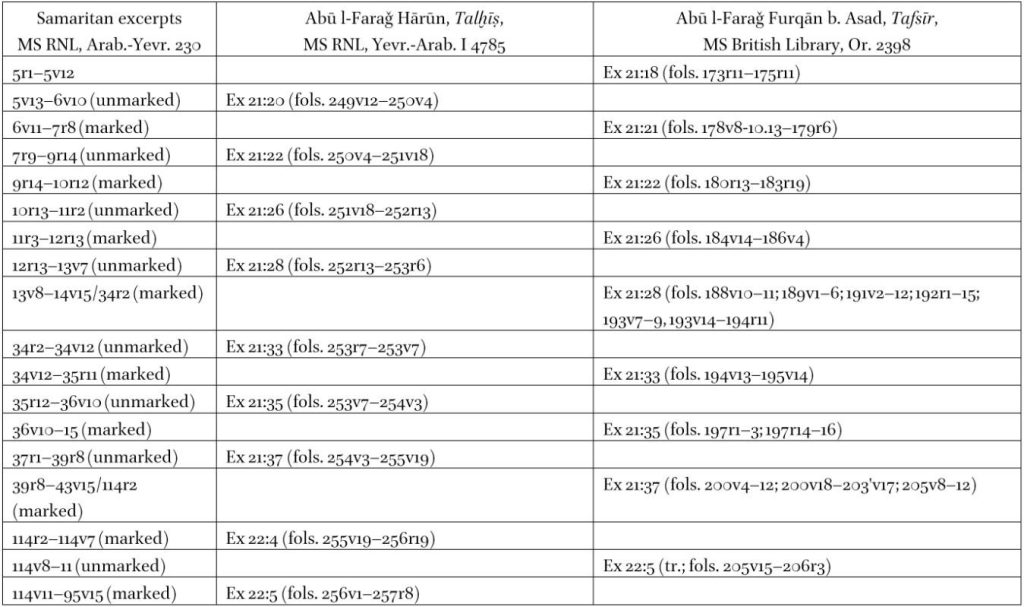
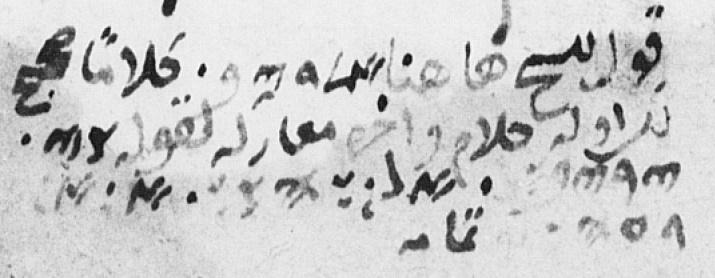
6. Except for a few lacunae, the extant excerpts from the two commentaries span Exodus 21:6 to Leviticus 11:46. They alternate for each verse or sense unit. Transitions between them are sometimes signposted by introductory formulae (see fig. 1), but often they are unmarked (see table below).

6. The following table covers a sequence of 22 consecutive folios (Arab.-Yevr. 230, fols. 5–14, 34–43, 114, 95) and displays the interweaving of the two commentaries with cross-references to text passages in manuscripts of the original compositions:
8. It is worth noting that the excerpts contained in this manuscript are unrelated to compilations from exegetical works made within the Qaraite tradition, such as those by Abū l-Ḥasan ʿAlī b. Sulaymān in the late 11th century. The Samaritan provenience of the manuscript and the excerpts is unmistakable for the following reasons:
(1) Marginal notes, alongside standard correction and collation marks, include several words and phrases in Samaritan script (see fig. 2).
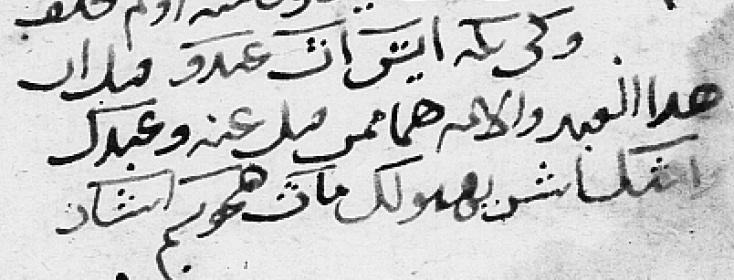
(2) The transcription of Hebrew Bible verses into Arabic script adheres to a letter-by-letter rendering that is characteristic of Samaritan Arabic manuscripts datable to the 13th-14th centuries (see fig. 3). It is designed to preserve the original spelling and contrasts with the phonetic transcription method prevalent in Qaraite manuscripts which is geared towards the Tiberian pronunciation tradition of biblical Hebrew.
(3) As a rule, the excerpts are tailored to fit the wording of the Samaritan Pentateuch. Passages and phrases that exclusively relate to the Masoretic Text version are usually omitted (see the sample text comparisons below).
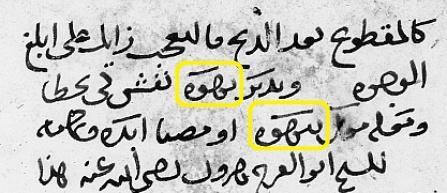
(4) The Tetragrammaton is rendered in the distinctive Samaritan four-letter transliteration into Arabic script (see fig. 4).
9. A comparison of these excerpts with Samaritan commentaries on the Pentateuch shows that they constitute a missing link in a crucial phase of the development of an important branch of the Samaritan exegetical tradition in Arabic.6 Here, I will confine the comparison to a representative section from two commentaries, namely the commentary on Exodus attributed to Ġazāl al-Duwayk (13th–14th c.) and the commentary attributed to Ibrāhīm b. Yaʿqūb al-Murǧān al-Danfī, known as “Ibrāhīm al-ʿAyyā” (d. 1783). The fact that these commentaries underwent a complex redactional process, involving revision and expansion over an extended period, need not detain us here. Their relationship to the Qaraite exegetical tradition pertains to their underlying structure and cannot be accounted for as the result of later editorial interventions.
10. As sample texts, I have chosen the commentaries on Ex 21:20-21, which lend themselves to a comparison due to the minor divergences between the Masoretic (מ) and the Samaritan (ש) text versions:
מ וכי יכה איש את עבדו או את אמתו בשבט ומת תחת ידו נקם ינקם
אך אם יום או יומים יעמד לא יקם כי כספו הוא
“And if a man strikes his servant, or his maid, with a rod, and he dies under his hand, he shall surely be avenged. But if he survives a day or two, he is not to be avenged, for he is his money.”
ש וכי יכה איש את עבדו או את אמתו ומת תחת ידו מות יומת
אך אם יום או יומים יעמד לא יומת כי כספו הוא
“And if a man strikes his servant, or his maid, and he dies under his hand, he shall surely be put to death. But if he survives a day or two, he is not to be put to death, for he is his money.”
11. The first synoptic table compares Ġazāl al-Duwayk’s commentary (MS Jerusalem, Ben-Zvi Institute, 7004b)7 with the Samaritan excerpts in Arab.-Yevr. 230 and Abū l-Faraǧ Hārūn’s Talḫīṣ. To facilitate the comparison, all three text versions are rendered in bi-alphabetical script.8 Noteworthy variations are highlighted in green.
| Ġazāl al-Duwayk, Tafsīr, MS Ben-Zvi Institute, 7004b, pp. 15:17–16:14 | Samaritan excerpts, MS Arab.-Yevr. 230, fols. 5v:13–6v:4 | Abū l-Faraǧ Hārūn, Talḫīṣ, MS Yevr.-Arab. I 4785, fols. 249v:12–250r:16 |
| וכי יכה איש את עבדו או את אמתו قيل هذا العبد والامة هما مما قيل عنه ועבדך | ואמתך אשר יהיו לך מאת הגוים وقوله וגם מבני התושבים הגרים עמכם | וכי יכה איש את עבדו قيل ان هذا العبد والامة هما ممن قيل عنه ועבדך ואמתך אשר יהיו לך מאת הגוים אשר | סביבתיכם. וגם מבני התושבים | וכי יכה איש את עבדו قيل هذا العبد والامة هما ممن قيل عنه ועבדך ואמתך אשר יהיו לך מאת הגוים וג׳ וגם מבני התושבים |
| وليس هما אזרח لتمييزه تعالى الاسرائيلي ممن تقدم ذكره في مثل ذلك كقوله ובאחיכם בני ישראל איש באחיו לא תרדה בו בפרך. والضرب هو ازيد من אלפרך. | و[ليس هما] אזרחים لتمييزه تعالى אלישראלי ممن تقدم ذكره في مثل ذلك كقوله ובאחיכם בני ישראל איש באחיו לא תרדה בו בפרך. والضرب هو ازيد من אלפרך. | وليس هما אזרחים لتمييزه تعالى אלישראלי ممن تقدم ذكره في مثل ذلك كقوله ובאחיכם בני ישראל איש באחיו לא תרדה בו בפרך. والضرب هو ازيد من אלפרך. |
| وليس هما ايضا من גר צדק المقول فيه וכי תקנה עבד עברי اذ قد يجوز ان يضربه اخر يوم من السنة السابعة(!) التي في غده יצא לחפשי חנם فلم يذهب له والحال هذا شي من ثمنه اذا مات بعد يومين، | وليس هما ايضا من גרי צדק المقول فيه כי תקנה עבד עברי اذ قد يجوز ان يضربه اخر يوم من السنة السادسة التي في غده יצא חפשי فلا يذهب له والحال هذه شي من ثمنه اذا مات بعد يومين، | وليس هما ايضا من גרי צדק المقول فيه כי תקנה עבד עברי اذ قد يجوز ان يضربه اخر يوم من السنة السادسة التي في غده יצא | לחפשי فلم يذهب له والحال هذه شي من ثمنه اذا مات بعد يومين، |
| فكيف يقال عنه כי כספו הוא. وليس עבד תרצח(!) ايضا لبطلان حكم כספו منه في السنة السابعة عند قوله אהבתי את אדני. | فكيف يقال عنه כי כספו הוא. وليس هو עבד נרצע ايضا لبطلان حكم כספו منه في السنة السابعة عند قوله אהבתי את אדוני. | فكيف يقال عنه כי כספו הוא. وليس هو עבד נרצע ايضا لبطلان حكم כספו منه في السنة السابعة عند قوله אהבתי את אדני. |
| فلا فرق بين הגר وبين هذا العبد مع مولاه الا ان كان يبقى يوم او يومين، ثم يموت فلا ينقاد مولاه به. ومتى مات عند ضربه له قيد به كالحُر … الذي يفيد قتله به قصاصاً. | فلا فرق بين الحر وبين هذا العبد مع مولاه الا ان كان يبقى يوم او يومين، ثم يموت فلا يقاد مولاه به. ومتى مات عند ضربه له قُيد به كالحُر كقوله נקם ינקם الذي يفيد قتله به قصاصاً. | فلا فرق بين الحر وبين هذا العبد مع مولاه الا ان كان يبقى يوم او يومين، ثم يموت فلا يقاد مولاه به. ومتى مات عند ضربه له قيد به كالحر كقوله נקום ינקם الذي يفيد قتله به قصاصاً. |
| This portion of the Talḫīṣ has been omitted, since בשבט is absent from the Samaritan Pentateuchal text. | وقوله בשבט يعني שבט מוסר يوذبه به اذ ليس له ضربه على غير طريق التاذيب لكنه قد يتفق مع ذلك وقوع אלשבט في بعض مقاتله فيموت او ان يزيد في ضربه בשבט خارجاً عن حد التاذيب، فان ضربه بحجر او بآلة حديد ومات بعد يوم او يومين. قيل انه يقتل لاجله من النص المتقدم اذ لم يقتصر على قوله וכי יכה איש את עבדו بل قيده בשבט. | |
| وقوله ומת תחת ידו يعني تحت ضرب يده له. | وقوله ומת | [תחת יד]ו يعني تحت ضرب يده له. | وقوله ומת תחת ידו يعني تحت ضرب يده له. |
| وقوله אך אם יום או יומים, قيل يعني يوم(!) خليقيًا من وقت الى مثله او بعض يومين قدرهما دون يوم كامل … | وقوله אך אם יום או יומים, قيل يعني يوما خليقيا من وقت الى مثله او بعض يومين قدرهما دون يوم كامل … | وقوله אך אם יום או יומים, قيل يعني يومًا خليقيًا من وقت الى مثله او بعض يومين قدرهما دون يوم كامل … |
12. The second synoptic table compares the corresponding section of Ibrāhīm al-ʿAyyā’s commentary with the Samaritan excerpts and Abū l-Faraǧ Hārūn’s Talḫīṣ. The text version of al-ʿAyyā’s commentary is based on MS Berlin, State Library of Berlin, Petermann I 4b, “a carelessly written copy”,9 which was reproduced in Meir Klumel, Mischpâtîm. Ein samaritanisch-arabischer Commentar zu Ex. 21-22,15 von Ibrâhîm Ibn Jakûb (Berlin: Itzkowski, 1902).10
| Ibrāhīm al-ʿAyyā, Tafsīr,MS Petermann I 4b, fols. 384r:6–384v:9 (ed. Klumel, p. xvii) | Samaritan excerpts, MS Arab.-Yevr. 230, fols. 5v:13–6v:4 | Abū l-Faraǧ Hārūn, Talḫīṣ, MS Yevr.-Arab. I 4785, fols. 249v:12–250r:16 |
| وقوله וכי יכה איש את עבדו או את אמתו اي وان يضرب رجل عبده او جاريته | וכי יכה איש את עבדו | וכי יכה איש את עבדו |
| قيل هذا العبد والامة هما ممّن قيل عنه وقوله ועבדיך ואמהותיך اي وعبيدك وجاريتك الذي يكونو لك من قبل الناس وايضا من اولاد الساكنين عندكم | قيل ان هذا العبد والامة هما ممن قيل عنه ועבדך ואמתך אשר יהיו לך מאת הגוים אשר | סביבתיכם וגם מבני התושבים | قيل هذا العبد والامة هما ممن قيل عنه ועבדך ואמתך אשר יהיו לך מאת הגוים וג וגם מבני התושבים |
| وليس هما صريحية لتميزه تعالى الاسراييلية ممن تقدم ذكره في مثل ذلك كقوله ובאחיכם בני ישראל איש באחיו לא תרדה בו בפרך اي وباخوكم(!) بني اسراييل الرجل باخيه لا تخدمه بعنف والضرب هو ازيد من العنف القارح(!) | و[ليس هما] אזרחים لتمييزه تعالى אלישראלי ممن تقدم ذكره في مثل ذلك كقوله ובאחיכם בני ישראל איש באחיו לא תרדה בו בפרך والضرب هو ازيد من אלפרך. | وليس هما אזרחים لتمييزه تعالى אלישראלי ممن تقدم ذكره في مثل ذلك كقوله ובאחיכם בני ישראל איש באחיו לא תרדה בו בפרך والضرب هو ازيد من אלפרך. |
| وليس هما ايضا من الجار الصادق المقول فيه וכי תקנה עבד עברי اي واذ تشتري عبد عبري | وليس هما ايضا من גרי צדק المقول فيه כי תקנה עבד עברי | وليس هما ايضا من גרי צדק المقول فيه כי תקנה עבד עברי |
| اذ قد يجوز ان يضربه اخر يوم من السنة السابعة(!) التي في غده يخرج لحريته فلم يذهب له والحال هذا شي من ثمنه اذا مات بعد يومين فكيف يقال عنه כי כספו הוא اي ان ماله هو. | اذ قد يجوز ان يضربه اخر يوم من السنة السادسة التي في غده יצא חפשי فلا يذهب له والحال هذه شي من ثمنه اذا مات بعد يومين، فكيف يقال عنه כי כספו הוא. | اذ قد يجوز ان يضربه اخر يوم من السنة السادسة التي في غده יצא | לחפשי فلم يذهب له والحال هذه شي من ثمنه اذا مات بعد يومين، فكيف يقال عنه כי כספו הוא. |
| وليس العبد يوسم ايضا لبطلان | حكم درهمه منه في السنة السابعة عند قوله אהבתי את אדני اي احببت مولاي. | وليس هو עבד נרצע ايضا لبطلان حكم כספו منه في السنة السابعة عند قوله אהבתי את אדני. | وليس هو עבד נרצע ايضا لبطلان حكم כספו منه في السنة السابعة عند قوله אהבתי את אדני. |
| فلا فرق بين الجار وبين هذا العبد مع مولاه الا ان كان يبقى يوم او يومين ثم يموت فلا ينقاد مولاه به ومتى مات عند ضربه له قيد به كالحر … الذي يقيد قتله به قصاصًا. | فلا فرق بين الحر وبين هذا العبد مع مولاه الا ان كان يبقى يوم او يومين، ثم يموت فلا يقاد مولاه به. ومتى مات عند ضربه له قُيد به كالحُر كقوله נקם ינקם الذي يفيد قتله به قصاصاً. | فلا فرق بين الحر وبين هذا العبد مع مولاه الا ان كان يبقى يوم او يومين، ثم يموت فلا يقاد مولاه به. ومتى مات عند ضربه له قيد به كالحر كقوله נקום ינקם الذي يفيد قتله به قصاصاً. |
| This portion of the Talḫīṣ has been omitted, since בשבט is absent from the Samaritan Pentateuchal text. | وقوله בשבט يعني שבט מוסר يوذبه به اذ ليس له ضربه على غير طريق التاذيب لكنه قد يتفق مع ذلك وقوع אלשבט في بعض مقاتله فيموت او ان يزيد في ضربه בשבט خارجاً عن حد التاذيب، فان ضربه بحجر او بآلة حديد ومات بعد يوم او يومين قيل انه يقتل لاجله من النص المتقدم اذ لم يقتصر على قوله וכי יכה איש את עבדו بل قيده בשבט. | |
| وقوله ומת תחת ידו اي ومات تحت يده يعني تحت ضرب يده له. | وقوله ומת | תחת ידו يعني تحت ضرب يده له. | وقوله ומת תחת ידו يعني تحت ضرب يده له. |
| وقوله אך אם יום או יומין اي بل ان يوم او يومين قيل يعني يومًا خليقيًا من وقت الى مثله او بعض يومين قدرهما دون يوم كاملاً(!) … | وقوله אך אם יום או יומים, قيل يعني يوما خليقيا من وقت الى مثله او بعض يومين قدرهما دون يوم كامل … | وقوله אך אם יום או יומים, قيل يعني يوماً خليقياً من وقت الى مثله او بعض يومين قدرهما دون يوم كامل … |
12. As these synoptic tables demonstrate, the two Samaritan commentaries and the excerpts by and large reproduce Abū l-Faraǧ Hārūn’s Talḫīṣ verbatim to the extent that the appertaining manuscripts may serve as secondary testimonies for a future critical edition of the Talḫīṣ.11 They skip, however, the passage from the Talḫīṣ relating to בשבט, which does not figure in the text version of the Samaritan Pentateuch. In addition, the commentary by Ibrāhīm al-ʿAyyā inserts Arabic translations of Bible verses into the commentary, introduced by the particle اي (ay = i.e.).
13. In light of this evidence, the dependence of Samaritan exegetical and legal literature in Arabic on Jewish scriptural interpretation must be regarded as far more profound than has hitherto been acknowledged. The close interweaving of the two exegetical traditions suggests that any serious study of the Samaritan exegetical tradition requires not merely a passing familiarity but a thorough acquaintance with Jewish Arabic exegesis in general, and with Qaraite exegesis in particular.12 Conversely, it follows that specialists in the Jewish Arabic exegetical tradition should devote greater attention to Samaritan Arabic literature.
This blog post was written within the framework of the ERC Consolidator Grant Project MAJLIS, ‘TheTransformation of Jewish Literature in Arabic in the Islamicate World’ (Grant agreement no. 101002243, LMU Munich) and the Cluster of Excellence EXC 3061/1 Cross-Cultural Philology.
References
- Tapani Harviainen and Haseeb Shehadeh, “How Did Abraham Firkovich Acquire the Great Collection of Samaritan Manuscripts in Nablus in 1864?” Studia Orientalia 73 (1994): 167–192 (https://journal.fi/store/article/view/45092); eidem, “The Acquisition of the Samaritan Collection by Abraham Firkovich in Nablus in 1864 – An Additional Document” Studia Orientalia 97 (2003): 49–63 (https://journal.fi/store/article/view/41627); Dan Shapira, “From ‘Our Exile’ to Sichem: Abraham Firkovicz Visits the Samaritans”, Cathedra 104 (2002): 85–94 [Hebrew] (https://www.jstor.org/stable/23405143). ↩︎
- I am currently preparing a catalogue of the Arabsko-yevreyski subsection of the Second Firkovich Collection. ↩︎
- https://web.nli.org.il/sites/NLIS/he/ManuScript/Pages/Item.aspx?ItemID=PNX_MANUSCRIPTS990001520330205171. ↩︎
- The Talḫīṣ is the subject of Miriam Goldstein, Karaite Exegesis in Medieval Jerusalem: The Judeo-Arabic Pentateuch Commentary of Yūsuf ibn Nūḥ and Abū al-Faraj Hārūn (Tübingen: Mohr Siebeck, 2011). For examples of a Samaritan reception of the Talḫīṣ see Gregor Schwarb, “Vestiges of Qaraite Translations in the Arabic Translation(s) of the Samaritan Pentateuch,” Intellectual History of the Islamicate World 1 (2013): 115–157 [133f.]. ↩︎
- Another well-known mid-fourteenth century Samaritan copy of Abū l-Faraǧ Furqān b. Asad’s Tafsīr is MS Oxford, Bodleian Library, Opp. Add. Qu. 99, covering Genesis 1–28. See the references in Schwarb, Vestiges, 132. ↩︎
- For an overview of Samaritan exegetical literature in Arabic see Frank Weigelt, “Die exegetische Literatur der Samaritaner”, in ‘Durch Dein Wort ward jegliches Ding!’ Zum Gedenken an Rudolf Macuch (1919 – 1993): 2. Mandäistische und samaritanistische Tagung, ed. Rainer M. Voigt (Wiesbaden: Harrassowitz, 2013): 343–390. ↩︎
- https://www.nli.org.il/en/discover/manuscripts/hebrew-manuscripts/itempage?vid=KTIV&scope=KTIV&docId=PNX_MANUSCRIPTS990038096590205171. For a brief description of the manuscript see Haseeb Shehadeh, “Al-Maḫṭūṭāt al-sāmiriyya fī maktabat Yad Yitzhak Ben-Zvi fī l-Quds al-ġarbiyya” (https://www.ahewar.org/debat/show.art.asp?aid=871101). ↩︎
- A vertical line refers to the beginning of a new page in the MSS. ↩︎
- Heinz Pohl, “Report of the MSS. of Dalīl as-sāʾil and Kāšif al-ghayāhib: Two Samaritan Commentaries to the Pentateuch”, Proceedings of the First International Congress of the Société d’Études Samaritaines, Tel-Aviv, April 11–13, 1988, eds. Abraham Tal and Moshe Florentin (Tel Aviv: Tel-Aviv University, 1991): 245–248 [246]. ↩︎
- https://www.nli.org.il/en/discover/manuscripts/hebrew-manuscripts/itempage?vid=KTIV&scope=KTIV&docId=PNX_MANUSCRIPTS990001757680205171. ↩︎
- It is an irony of history that the Talḫīṣ, which was originally written in Arabic script, has for the most part only survived in Hebrew script manuscripts, while the secondary Samaritan reception has preserved a sizeable part of it in Arabic or bi-alphabetical script. ↩︎
- This view has been corroborated in recent articles by Arye Zoref, “The Figure of Hagar in Samaritan Exegesis”, Moreshet Yisraʾel 22,2 (2024): 143–162 [Hebrew] (https://doi.org/10.26351/MI/22-2/1) and “The Blessings of the Tribes in Samaritan Exegesis in Light of the Commentary of Yefet ben ʿEli the Qaraite”, A.B. Ḥadašot ha-Šomronim 1367-1368 (1 July 2022): 11–32 [Hebrew]. Zoref has, moreover, studied an example of early Rabbanite reception of Qaraite exegesis: “The Biblical Commentary of ʿEli b. Yisrael on David Stories in Light of Yefet b. ʿEli’s Commentary”, Sefunot 27 (2022): 327–371 [Hebrew]. For examples of a Samaritan reception of the Christian commentary tradition see Frank Weigelt, “Die Hexaemeron-Tradition bei Juden und Samaritanern: Der Genesiskommentar von Ṣadaqa b. Munaǧǧā”, in Samaritan Languages, Texts, and Traditions: Collected Studies, ed. S. Schorch (Berlin: De Gruyter, 2025): 242–279. ↩︎
Gregor Schwarb is a Senior Research Fellow in Judaic Studies at the Ludwig Maximilian University of Munich. He is currently contributing to two major research programmes: the ERC-funded project MAJLIS (The Transformation of Jewish-Arabic Literature in the Islamic World) and the LMU’s Cross-Cultural Philology Cluster of Excellence. He studied Theology (specialising in Biblical Studies) and Philosophy in Fribourg (Switzerland), Jerusalem, and Damascus, and holds a PhD in Islamic Studies from the Freie Universität Berlin, where he was a founding member of the Research Unit “Intellectual History of the Islamicate World”. His research explores the history of intellectual and exegetical traditions in the pre-modern Islamicate world through a trans-denominational and comparative lens. Driven by both methodological rigour and historiographical priority, his work transcends established disciplinary boundaries, moving beyond the real or imagined divisions that separate religious communities and schools of thought. Within the framework of the MAJLIS project, he is currently compiling a catalogue of more than 650 Qaraite manuscripts written in Arabic script.
Suggested Citation: Gregor Schwarb, “Exegetical Crossroads: Tracing the Profound Qaraite Footprint in Samaritan Arabic Bible Interpretation”, Munich Research Centre for Jewish-Arabic Cultures Blog, 24 June 2026, URL: https://www.jewisharabiccultures.fak12.uni-muenchen.de/exegetical-crossroads-tracing-the-profound-qaraite-footprint-in-samaritan-arabic-bible-interpretation/. License: CC BY-NC.
